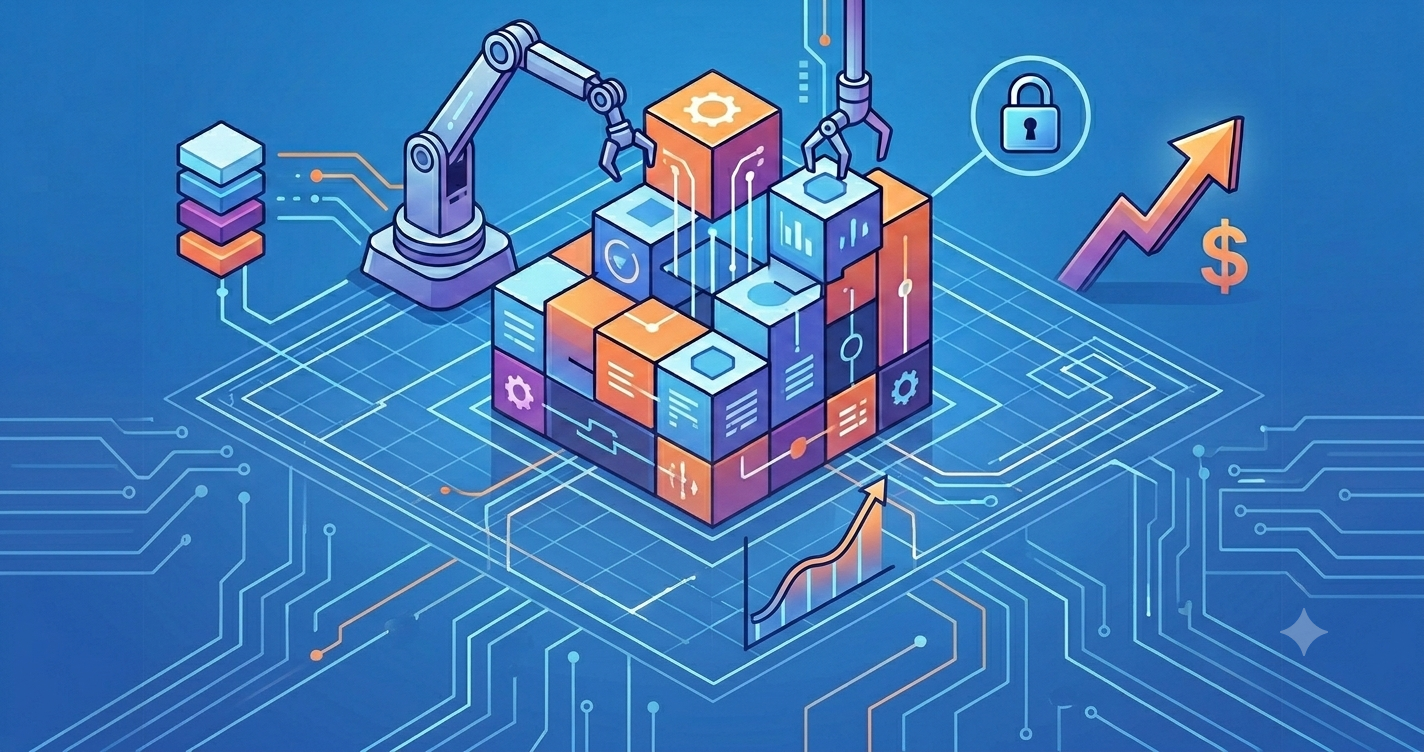
Engineering Strategy: Architecture for Financial Sustainability and Growth
When scaling a high-growth Software as a Service (SaaS) product with constrained capital, the technical architecture is not merely an implementation detail—it is our primary financial mechanism. Our strategy must solve a dual mandate: achieving rapid feature velocity while guaranteeing rock-bottom operational expenditure (OpEx).
We select technologies that don't just perform well; they fundamentally maximize performance per dollar spent and minimize systemic risk exposure at scale, extending our path to profitability.
🚀 Pillars of Deterministic Business Efficiency
Our stack is built upon foundational pillars designed to ensure predictability, minimal overhead, and resilience against common cloud vulnerabilities:
1. Predictable Cost Performance: Rust for Resource Optimization
The core application logic is written in Rust. This provides critical financial advantages over traditional interpreted or VM-based stacks (e.g., Python/Node.js). By enforcing compile-time memory safety, type checking, and predictable resource usage, the result is a lower Total Cost of Ownership (TCO), allowing us to support larger user bases with significantly smaller cloud billing statements as we scale.
We utilize battle-tested, performance-oriented libraries like axum for our web services layer and sqlx for asynchronous database interaction. These choices ensure that both network handling and data access benefit from compile-time guarantees and minimal overhead.
Furthermore, Rust's strict compiler guarantees enable "fast and fearless refactoring," drastically reducing bugs found in production that consume expensive engineering time — estimated at $X per incident, multiplied by reduced Mean Time To Repair (MTTR). This focus on compile-time rigor translates directly into higher developer velocity and fewer operational surprises.
2. Maximizing Compute Value: Dedicated AWS Graviton Utilization
All services are deployed exclusively on AWS Graviton processors. By utilizing the native ARM architecture, we achieve a substantial performance-per-dollar uplift compared to standard x86 instances, maximizing our compute budget.
Furthermore, leveraging dedicated physical cores ensures consistent P99 latency—a non-negotiable requirement for enterprise Service Level Agreements (SLAs), mitigating revenue risk caused by unpredictable slowdowns.
3. Minimizing Operational Risk: Hardened and Auditable Infrastructure
To guarantee maximum security, compliance, and cost predictability, our deployment model is rigorously controlled:
Streamlined Dependencies: We use Musl to achieve static compilation across all services. This process eliminates complex runtime dependencies that create "dependency hell"—a major source of vulnerabilities and operational complexity—thereby reducing the attack surface area.
Auditable Components: Containers are built from hardened base images (e.g., Chainguard). These provide verifiable Software Bill of Materials (SBOMs), giving us absolute, quantifiable transparency into every component, critical for compliance and rapid vulnerability response.
Principle of Least Privilege: Isolation is enforced using rootless Podman. This guarantees that all processes run with restricted, least-privilege capabilities. This minimizes the potential impact of any single breach, protecting the host kernel and maintaining core service uptime—a vital business continuity guarantee.
📊 Performance Assurance: Measurement as a Strategic Tool
The reliability required for enterprise clients cannot be assumed; it must be measured deterministically. We employ an observability stack built around Loki, Grafana, and Tempo. This combination delivers unified monitoring (Metrics, Logs, Traces) without the expensive vendor lock-in or operational drag of monolithic APM tools.
By correlating highly granular logs with fine-grained service traces, we proactively identify efficiency drift or resource contention before it degrades the user experience, protecting our reputation and maximizing uptime guarantees.
🛡️ Systematic Risk Mitigation: Security Built into Architecture
We treat security not as a costly feature to bolt on, but as an architectural constraint that dictates risk reduction. Our system actively closes known attack vectors to ensure that even if one component is compromised, the overall architecture remains isolated and functional, protecting revenue streams.
Extreme Process Isolation: The combination of rootless Podman and minimal base images enforces robust process boundaries (Namespaces). By achieving static compilation with Musl onto a dedicated scratch image, we eliminate unnecessary binaries or utilities required for traditional container escapes.
Network Containment: Service communication is strictly limited: all application-to-database traffic occurs only over a restricted internal loopback link. This containment strategy significantly reduces the potential "blast radius" of any breach, protecting critical data assets and mitigating legal risk.
💸 OpEx Mandate: Funding Our Growth Runway
We operate under a self-funding model. Unlike competitors with unlimited capital, our success is directly tied to optimizing the 'Time to Profit.' Every architectural decision detailed here is viewed through a cost optimization lens. Wasted compute time or over-provisioned services directly deplete our finite capital runway.
This mandatory perspective forces us to prioritize extreme resource efficiency over engineering convenience—making performance not just a technical goal, but a non-negotiable financial metric for the business model itself.
📈 Conclusion: Resilience Fuels Profitability
This hyper-efficient stack is engineered primarily for maximum resource utility and minimum operational expenditure (OpEx). In our bootstrapping phase, our core technical objective is directly translating into maximizing financial runway—the time and resources needed to scale product quality before hitting critical cost thresholds.
Our deep commitment to performance, security hardening, and resource optimization is fundamental to transforming a complex technical achievement into a resilient, profitable business model with predictable scaling costs.
⚠️ Operational Roadmap: Scaling Beyond Bootstrap Efficiency
The architecture detailed above represents our current minimum operational expenditure state. It is hyper-optimized for maximizing financial runway while achieving critical user mass and positive cash flow.
This initial setup prioritizes resource density and low overhead capacity. Once profitability is secured, the system will evolve strategically (e.g., adopting specialized service meshes) to improve feature complexity without compromising our proven security principles or OpEx-driven methodology.