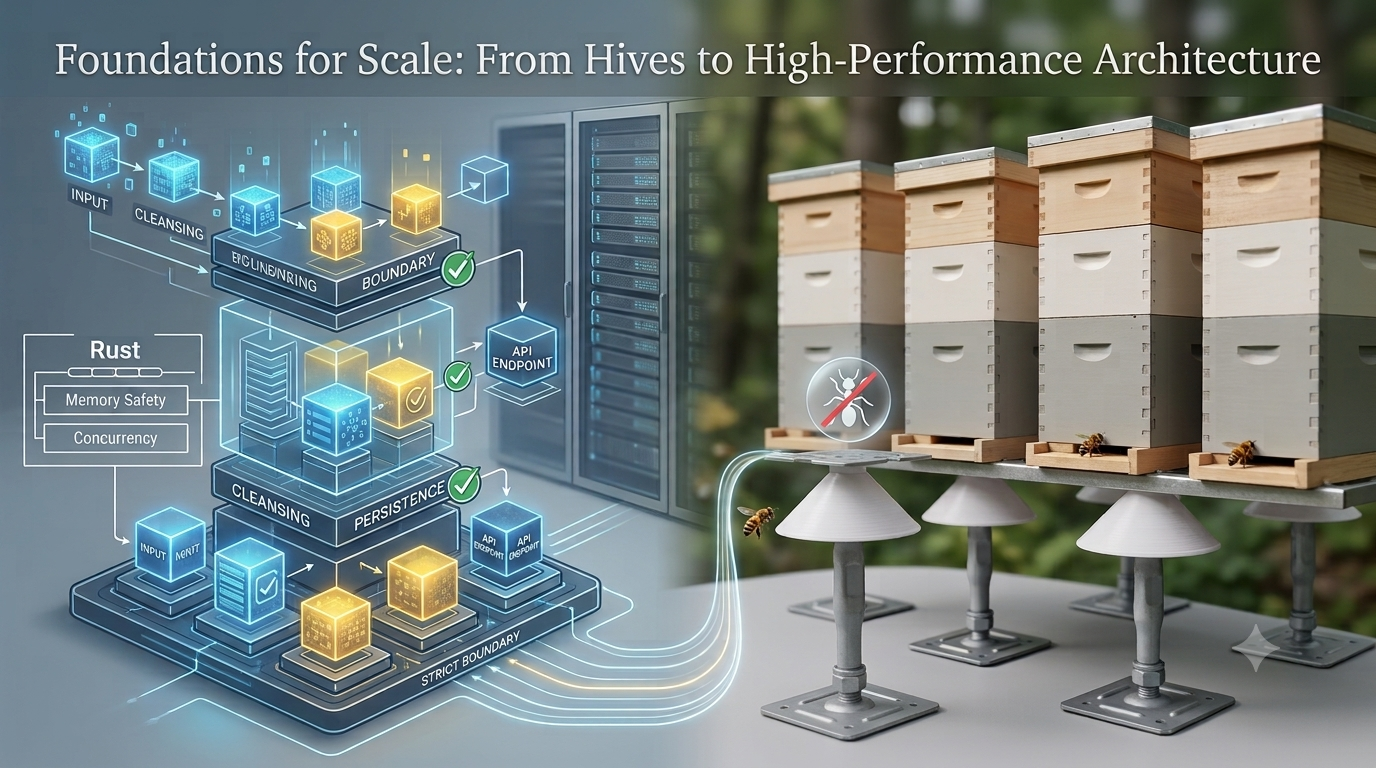
Note on AI usage: The concepts, experiences, and technical analogies in this post are entirely my own. I utilized an AI collaborator to help structure the outline and clean up the prose.
Why Shortcuts in Software Architecture and Beekeeping Cost You Later
There is a distinct thrill in a fast start.
Whether you are launching a new software product or setting up a new habitat for a swarm of honey bees, the initial momentum is intoxicating. The app is live; the bees are moving in. Everything works.
But in both engineering and apiculture, success has a way of magnifying early shortcuts. If you don't spend time building a thoughtful foundation when the project is light, you will find yourself paying a compounding tax when the project gets heavy.
Here is what keeping traditional Japanese jukabako (stacked box) hives taught me about software architecture.
1. The Temptation of the Quick Start
When a new swarm arrives, the temptation is to get them housed as quickly as possible. In Japan, a traditional jukabako hive is beautifully simple—a stack of wooden boxes where bees build their comb downward naturally.
Because it’s so modular, it’s easy to skimp on the base. You’ll often see hives rested on a couple of loose concrete blocks or a flipped-over plastic basket. It’s fast, it’s cheap, and guess what? The bees don't care. They move right in and start building.
We do the exact same thing in software. When starting a new project, the temptation is to grab a default dynamic setup, skip the strict data boundaries, and just start shipping features. It's fast, it's cheap, and it works beautifully out of the box.
You've essentially signed a lease on technical debt.
2. When the "Bugs" Move In
A hive sitting on a basic, unprotected concrete block is an open invitation. It doesn't take long for ants to find a direct highway straight up into the honey.
Once the ants arrive, the beekeeper’s life changes. Instead of managing the colony, you are constantly fighting fires. You are putting out traps, brushing away pests, and stressing out the bees.
In software, a sloppy initial setup invites a different kind of bug. Because the architecture lacks clear separation of concerns or a robust testing strategy, technical debt creeps in. What should be a simple feature deployment turns into an afternoon of chasing regressions. Soon, the engineering team is spending 80% of their time fighting fires and only 20% building value.
If you don't design a "bug-blocking" base from day one—whether that’s an ant-proof stand for a hive, or clean architectural boundaries for your code—you inherit a permanent maintenance tax.
3. The Weight of Success (The Scalability Trap)
Let’s say your sloppy setup beats the odds. The app grows; the bee colony thrives.
It’s a great season, and the bees have built downward rapidly. Suddenly, your jukabako hive is four or five stories high. It is incredibly heavy, packed tight with thousands of bees and fragile, heavy wax comb filled with honey.
Then you notice the foundation. The makeshift base is starting to tilt, or the ant infestation has become critical.
Fixing it now is a nightmare. Lifting a top-heavy, 40-kilogram hive to swap out a rotten bottom board is terrifying. One slip, and the entire colony collapses, destroying months of work.
This is the exact trap companies fall into with their tech stacks. You started with a fast, loosely-coupled setup. Now, you have millions of database records, high traffic, and a heavy, interconnected monolith.
Performance is tanking, or you desperately need to migrate your core database layer. But changing the foundation now is a high-stakes operation. The stack has become too heavy to easily shift. Because everything is coupled together, a single mistake at the base layer could cause a catastrophic outage.
Inertia sets in. Teams stop refactoring because the cost of failure is simply too high.
4. Invest in the Base
The lesson here isn't that you need to over-engineer everything from day one. You don't need a massive, complex system for a swarm that hasn't arrived yet.
But you do need to respect the foundation.
Spending an extra weekend building a leveled, stable, ant-proof stand for a hive pays dividends for years. It ensures that when the hive grows to five stories, you never have to worry about the bottom rotting out.
Embracing a stricter architecture—or taking the time to build your core infrastructure in a language like Rust—does the exact same thing for your engineering team. The upfront cost might feel high, and it certainly changes the speed of your first week. But a good foundation doesn't slow you down; it is the only thing that allows you to keep growing safely without the whole tower collapsing under its own weight.